
How Does an 8-GPU Flagship Feed Its GPUs? TFNEW S748E5
TL;DR: TFNEW launched the S748E5, its 4U/5U 8-GPU flagship server, on September 21, 2026. Powered by up to 2x AMD EPYC™ 9004/9005 processors (500 W TDP) with 24 DDR5 DIMM slots and 12 front hot-swap LFF bays, it drives eight 600 W dual-width GPU cards over either a passthrough or a switch interconnect — the platform behind multi-GPU training and inference clusters. Get specs and pricing: sales@tfnew.com.
Core Specifications (with Plain-Language Terms)
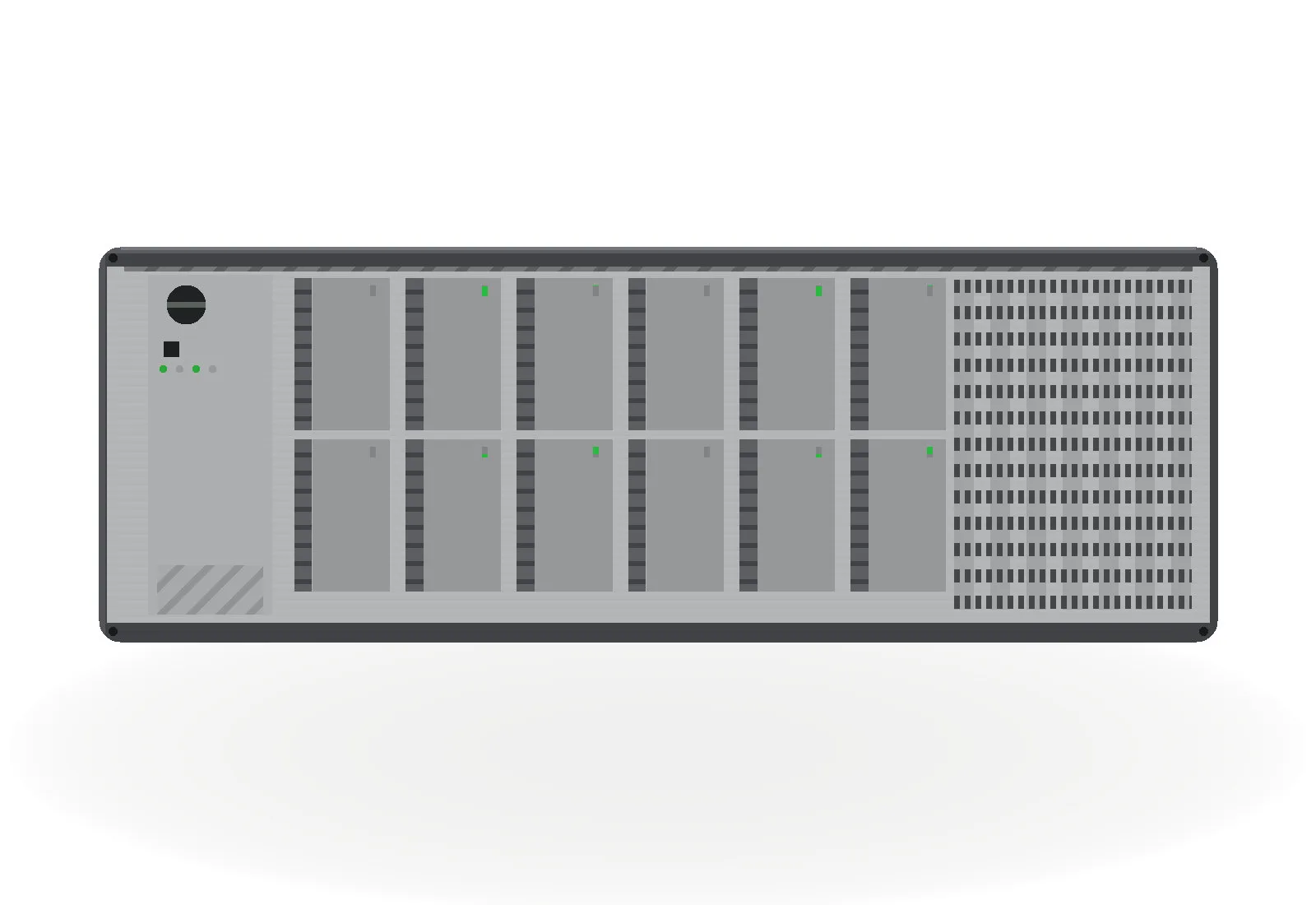
The S748E5 is a 4U (or 5U, depending on GPU card height) rackmount server built to feed eight 600 W dual-width GPU cards. "Dual-width" means a card occupies two PCIe slot widths and its own cooling volume — that is the physical class of A100/H100-style accelerators. The chassis picks a 4U or 5U height to match the card type, and offers two ways to connect the GPUs: a passthrough scheme (each GPU talks to the CPU directly over its own PCIe 5.0 lanes, up to 11 standard slots) or a switch scheme (GPUs go through an NVSwitch-style interconnect, up to 13 slots) for GPU-to-GPU traffic-heavy training. The platform runs up to two AMD EPYC 9004/9005 processors at 500 W TDP (ambient must stay below 25°C for that part), 24 DDR5 DIMM slots at up to 6400 MT/s across 12 memory channels per CPU, and 12 front 3.5-inch hot-swap bays (with a passthrough/switch-dependent SATA-SAS-NVMe mix) plus an internal M.2. Power is four hot-swap modules at 2000 W or 2700 W in N+1 redundancy; cooling is N+1 redundant hot-swap fans with intelligent speed control. Management runs on an integrated BMC with IPMI 2.0, Redfish, SOL, KVM and virtual media.
Specs at a Glance
| Item | S748E5 Value |
|---|---|
| Form factor | 4U (or 5U) rackmount, 822 D × 448 W mm |
| Processor | Up to 2x AMD EPYC 9004/9005, TDP up to 500 W |
| Memory | 24x DDR5 DIMM slots, 12 channels per CPU, up to 6400 MT/s |
| Storage | 12x front LFF hot-swap bays (SATA/SAS/U.2 NVMe mix) + internal M.2 |
| GPU | Up to 8x 600 W dual-width cards (passthrough or switch scheme) |
| PCIe | 11 (passthrough) / 13 (switch) standard PCIe 5.0 slots |
| Power | 4x hot-swap 2000 W / 2700 W, N+1 redundant |
| Management | BMC: IPMI 2.0, Redfish, SOL, KVM, virtual media |
| Security | Optional TPM/TCM, open-cover intrusion detection, lockable top cover |
| Environment | 5°C–35°C operating |
Why the Interconnect Choice Is the Real Spec
The GPU count is headline; the interconnect is architecture. Passthrough (direct GPU-CPU lanes) keeps latency low and wiring simple for workloads that mostly run inside one model per GPU — common in inference farms. Switch (GPU-to-GPU fabric) keeps tensors moving between cards rapidly during training, where every epoch is a gang conversation. The S748E5 ships both topologies in the same chassis family, so the same 4U/5U platform serves an inference cluster one quarter and a training rack the next — without changing servers.
Where It Fits
- Multi-GPU training: eight 600 W cards on a switch fabric for LLM fine-tuning and large-model runs
- Inference farms: passthrough topology with 12 LFF bays for model data and logs at the node
- Enterprise virtualized GPU: EPYC memory bandwidth (12 channels per CPU) for mixed GPU-vCPU workloads
- Research clusters: 500 W-class EPYC headrooms with IPMI/Redfish automation in academic datacenters
Why the Numbers Matter
- 8x 600 W dual-width GPUs: flagship accelerator density in one chassis, 4U or 5U
- 2x EPYC 9004/9005 @ 500 W TDP: CPU headroom that keeps up with eight GPUs
- 24x DDR5 @ 6400 MT/s: memory bandwidth for model weights and training data
- 12 memory channels per CPU: EPYC's bandwidth advantage for data-heavy kernels
- N+1 power, N+1 fans: the availability margins a production GPU fleet needs
What TF NEW Says
"After the GPU count, the first question is always the fabric," said a TF NEW product manager. "The S748E5 answers with both topologies on one platform — passthrough for inference, switch for training — around two 500 W EPYCs, 24 DIMM slots and 12 hot-swap bays. We build the chassis, the power plan and the cooling around the GPU class, so the fleet runs instead of throttling."
Quality and Availability
Every S748E5 runs 48 hours of burn-in under full GPU load, with the power subsystem validated against eight 600 W cards before shipping. The chassis ships deployment-ready with IPMI/Redfish baselines and a documented GPU compatibility matrix. 4U and 5U variants, passthrough and switch topologies are configurable at order time.
Pricing and Availability
The S748E5 is available now. Pricing varies with chassis height, CPU, interconnect topology and power configuration. Contact sales@tfnew.com or use the request-a-quote form at www.tfnew.com/contact for configuration guidance and lead time.
About TF NEW
TF NEW (TF New Technology) is an enterprise AI infrastructure provider based at www.tfnew.com. It designs and delivers private AI, compute, networking, storage, cooling and edge systems as deployment-ready solutions — AI servers, AI workstations, edge AI, liquid cooling and enterprise rack servers — for AI factories, datacenters and edge projects worldwide.
Media Contact
TF NEW | sales@tfnew.com | www.tfnew.com/contact
FAQ
- How many GPUs does the S748E5 support? Up to eight 600 W dual-width GPU cards, in passthrough or switch interconnect topology.
- What processors does it use? Up to two AMD EPYC 9004/9005 series processors with TDP up to 500 W.
- What is the difference between passthrough and switch? Passthrough connects each GPU directly to the CPU (low latency, simpler); switch adds a GPU-to-GPU fabric for training traffic.
- How much memory does it take? 24 DDR5 DIMM slots at up to 6400 MT/s across 12 memory channels per CPU.
- What storage does it have? 12 front hot-swap 3.5" bays with a SATA/SAS/U.2 NVMe mix, plus one internal M.2.